
Blocking and randomization in DOE: managing day and instrument effects
Plan blocks and randomize within real lab constraints to keep treatment effects interpretable across days, instruments, and operators.
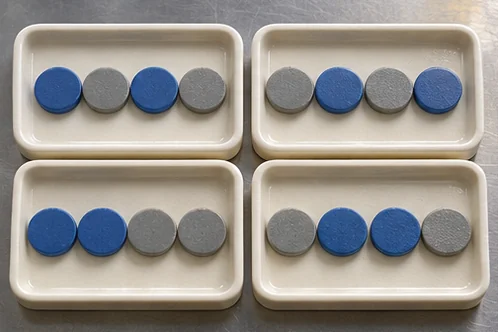
Block on a source of variation you expect to matter and can identify before the experiment, such as day, device or operator. Compare the settings you care about within those blocks. Randomize the assignment or order wherever the schedule allows, so a nuisance trend is less likely to favor one setting systematically.
Start by writing down the treatment factor, the smallest unit it can be assigned to, and the nuisance factors that may change the reading. For example, the setting may change between cards, equipment drift may change between days, and the instrument may have a single daily setup. The assignment level determines the comparison your analysis can support.
Comparing both settings on each day
A team wants to compare two optical-reader settings using independent inert calibration cards. Each day allows two cards, one per setting. Assign settings to cards independently within each day subject to that balance, and randomize the order to avoid always running one setting first. Each day contains both settings, so it is a complete block for this comparison.
The table gives one possible order and synthetic readings. Setting B reads lower than A by 1.00, 2.00, 0.50, and 1.50 units across the four days. The average within-day difference is −1.25 units. The daily baseline changes considerably, but every comparison is made on the same day. Inspect the spread of those four differences and report uncertainty. The estimate alone cannot establish whether −1.25 units is important or whether the pattern will carry over to other readers.
| Day | Randomized order | A reading | B reading | B − A |
|---|---|---|---|---|
| 1 | A, then B | 14.00 | 13.00 | −1.00 |
| 2 | B, then A | 20.00 | 18.00 | −2.00 |
| 3 | B, then A | 11.00 | 10.50 | −0.50 |
| 4 | A, then B | 17.50 | 16.00 | −1.50 |
| Average | — | 15.63 | 14.38 | −1.25 |
Check overlap before booking sessions
Putting A on the first two days and B on the last two would combine the effects of setting and day. Adding day to a model cannot reconstruct within-day comparisons that the team never made. Before booking, count how many blocks include each setting and which pairs can actually be compared.
If three settings cannot all fit into one session, use a connected incomplete-block plan. Sessions covering pairs A and B, B and C, and A and C can preserve overlap, for example. The exact plan should account for the precision you need, the number of independent blocks available, and the analysis you intend to use. A lost session can matter more in a sparse plan than in a complete one.
Handle settings you can change only at the session level
Sometimes the reader mode cannot change between cards. If a mode is assigned once per session, the session is the experimental unit for that factor. Schedule independently assigned sessions for each mode. When a second factor varies among cards within sessions, the design may need separate randomization at session and card levels and a split-plot analysis.
Keep separate counts of independently assigned sessions and cards measured within them. A session with many cards can provide detailed information about within-session variability. Its readings still share a single mode assignment. If the important setting depends on an instrument with only one available device per mode, that restriction may prevent a clean comparison.
Make randomization and deviations reviewable
- Save the planned run order, assignment rules, and any seed used to generate the allocation. Record the actual order alongside it.
- Document cancellations, repeats, calibration failures, and any reason you changed a setting or swapped a session.
- Review whether a deviation reduced treatment overlap inside a block or changed the unit that received the setting.
- Plan the blocked or paired comparison before collecting data. Afterward, inspect the differences by block for unusual patterns and keep the interpretation within the days, devices, and conditions represented.